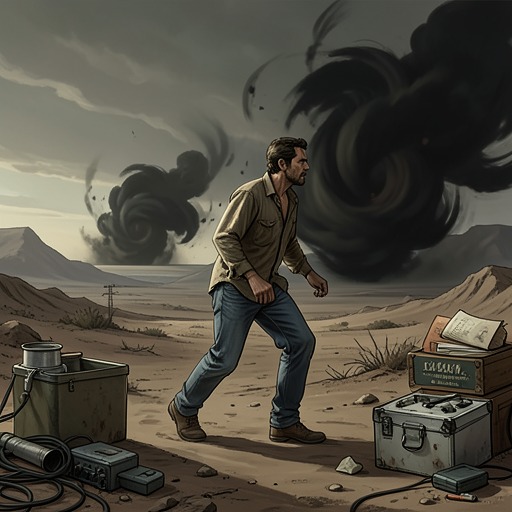
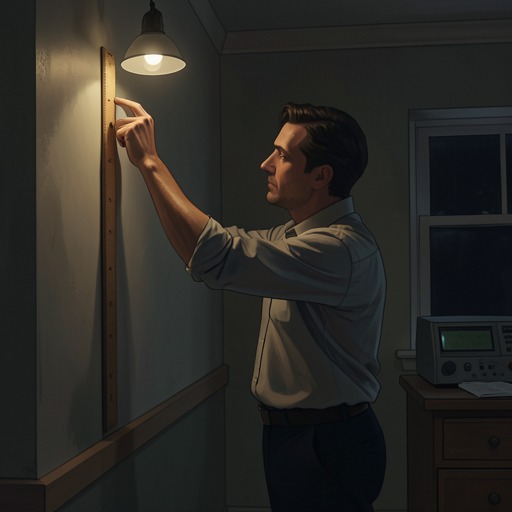
The Instinct to Survive
The Shrinking ManThe Instinct to Survive names the force that keeps Scott Carey acting as his body grows smaller and his prospects narrow. It is not presented as a simple, triumphant will to live: Scott repeatedly questions whether his efforts express a meaningful choice or merely an automatic impulse. The concept takes shape in the gap between his despair and his continued struggle, and in the recognition that awareness itself can be both torment and a means of preserving his sense of self.
Definition and Pattern
For a year and a half, Scott has tried to imagine becoming so small that he would disappear. His mind repeatedly resists the thought, offering hopes that the injections will work, that the shrinking will stop on its own, or that something else will intervene. But the imagined endpoint is no longer safely abstract: he is so small that he expects to be gone in six days. This forecast gives his survival instinct an immediate pressure. The future he had been unable to visualize now appears as a deadline, while his persistent efforts to live have not made the shrinking level off.
Despair does not cancel the instinct. When it overwhelms him, Scott lies for hours on his makeshift bed, indifferent to whether he lives or dies, and twists in restless agony. He wonders why he ran from the spider instead of allowing it to catch him. Being killed would be hideous, but, he reasons, it would be quick and would end the despair. Yet he has continued to flee, improvise, struggle, and exist. The contradiction is central: he can imagine surrender as relief, but his behavior keeps refusing it.
Flight, Despair, and Choice
Scott understands his pattern as a series of retreats. Since the shrinking began, he has run physically from threats including a man, boys, a cat, a bird, and a spider; alongside this flight, he identifies a mental retreat from life, problems, and fear. His account moves beyond evasion of immediate danger to include backtracking, yielding, and giving in. Even the practical struggle for food and water fails to settle what his actions mean: those efforts might show a decision to continue, or they might follow inevitably from being alive.
That uncertainty becomes a question about personhood. Scott asks whether he remains a separate and meaningful individual, whether he matters, and whether mere survival is enough. He cannot decide whether he is a man trying to face reality or only a pitiful fraction of a shadow, driven by habit and impulse, moved by events without himself moving or fighting. The passage does not resolve the alternatives. His ability to name them shows sustained self-examination, but reflection alone does not prove that his daily struggle has become a deliberate choice. He falls asleep curled up and shivering, no bigger than a pearl, still without an answer.
The Thimble and the Work of Continuing
The question returns in a concrete crisis over water. A thimble contains the only available supply, but its smooth, slightly overhanging sides rise six feet above Scott. He tries to push it over and fails because it is too heavy; the thread he carries does not reach. Exhaustion gives way to the thought that he might as well die, but he recognizes this response as the old, childish idea of punishing the world by dying. The water makes the stakes plain: either he gets it, or he dies without anyone knowing or being affected.
Scott clenches his teeth and searches for pebbles, trying to find a way to reach the water. The action does not settle whether instinct or will is driving him; instead, his bewilderment about that motive becomes part of the ordeal. He wonders why he tries so hard, even as he continues looking for a practical solution. The scene gives survival a material form—water, a vessel too heavy to move, a thread too short to help—and shows that the abstract question of purpose accompanies even the smallest necessary task.
Awareness and the Mind
While thirsty and hungry, Scott reaches a more affirmative recognition: awareness of shrinking may be the curse more than shrinking itself. He imagines that it would have been easier to lose his human brain and undergo each physical reduction without fully understanding it. Consciousness forces him to experience the downward change as it happens, rather than sheltering him from its meaning.
Yet the mind that makes the process so painful also marks Scott as distinct. Even when spiders are larger than he is and flies or gnats can shade him with their wings, he still possesses his mind. He recognizes that it may be his salvation, just as it has been his damnation. This is not a claim that thought can stop his bodily decline or supply a solution to every immediate danger. Its importance is narrower and more precarious: amid the reversal of ordinary scale, mental awareness remains a ground on which he can recognize himself as more than a creature responding mechanically to threat.
Significance and Limits
The Instinct to Survive is defined less by confidence than by persistence without certainty. Scott may lie indifferent to life, imagine death as an end to suffering, and condemn his own efforts as habitual; nevertheless, he keeps escaping predators, seeking food and water, and trying to solve immediate problems. His actions resist any clean division between a freely chosen will and bodily impulse. The narrative makes that ambiguity consequential rather than treating survival as proof that despair has been overcome.
The thimble episode and Scott’s recognition of his mind offer two related but distinct supports: the first shows him acting because water is necessary, while the second gives that continued action a possible relation to individual identity. Neither erases his fear, his uncertainty, or the six-day prospect of disappearance. The instinct therefore remains both an engine of survival and a question about what survival means when the self is changing and the future appears finite.